
QbCheck ADHD Testing at Lucent Psych — Objective, FDA-Cleared ADHD Assessment via Telehealth
- Lucent Psych
- Dec 22, 2025
- 11 min read

QbCheck ADHD Testing at Lucent Psych — Objective, FDA-Cleared ADHD Assessment via Telehealth for Adults

Objective ADHD testing with FDA-cleared tools can change how adult ADHD is identified and managed, and QbCheck is one such test that provides measurable attention and activity data remotely. This article explains what QbCheck is, how it measures inattention, hyperactivity, and impulsivity, and why FDA clearance matters for clinical reliability. You will learn a step-by-step telehealth assessment workflow, practical preparation tips for an online QbCheck session, how objective data integrates with clinical interviews and rating scales, and how objective testing supports treatment monitoring. The guide also covers the benefits of telehealth delivery, how objective measures improve diagnostic accuracy compared with subjective reports, and how clinicians use repeated testing during medication management and therapy. Finally, we outline Lucent Psych’s telehealth services—structured evaluations, medication management, and follow-up testing—tied to how QbCheck data informs personalized care for adults in Texas and Washington. Read on to understand evidence-based uses of QbCheck and practical next steps for scheduling a telehealth ADHD assessment.
What Is QbCheck? Understanding the FDA-Cleared Objective ADHD Test
QbCheck is an objective ADHD assessment that combines a computerized continuous performance task with motion-tracking to quantify attention, impulsivity, and activity levels, providing clinicians with standardized scores relative to normative data. The test records response accuracy and timing on attention tasks while using webcam-based motion capture to measure movement that corresponds to hyperactivity, producing discrete metrics clinicians can interpret alongside history and rating scales. Because QbCheck is FDA-cleared, it has undergone regulatory review for use as a medical device in clinical assessment, which supports its adoption in diagnostic workflows as an evidence-based objective measure. Below is a concise summary of QbCheck attributes to help clinicians and patients understand the test components and outputs before we explore how it measures specific ADHD domains.
QbCheck attributes at a glance:
Feature | Characteristic | What It Provides |
Manufacturer | Qbtech | Commercial developer of QbCheck |
Test Type | Computer-based continuous performance test (CPT) + motion tracking | Objective metrics for attention, impulsivity, hyperactivity |
Regulatory Status | FDA-cleared (510(k) cleared) | Clinical validation for diagnostic support |
Required Equipment | Computer with webcam and internet | Remote administration via telehealth |
Outputs | Attention metrics, impulsivity indices, motion scores | Standardized report with normative comparisons |
This table clarifies core QbCheck components and helps set expectations for how results will appear in a clinical report. Next, we’ll examine how the test captures each ADHD symptom domain in measurable terms.
How Does QbCheck Measure ADHD Symptoms Like Inattention, Hyperactivity, and Impulsivity?
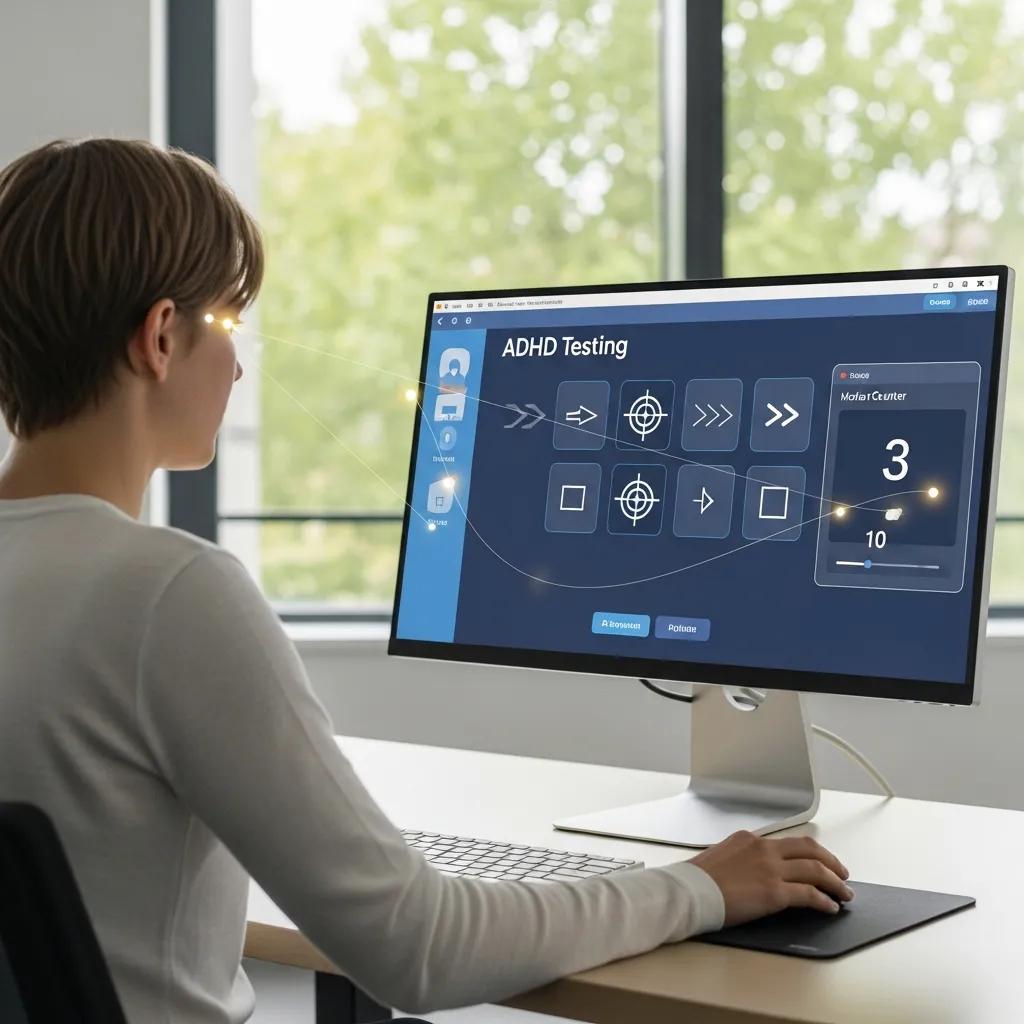
QbCheck measures inattention primarily through performance on a timed, repetitive stimulus–response task where lapses, omissions, and reaction-time variability indicate attentional control issues. Impulsivity is inferred from commission errors and unusually fast response patterns that suggest premature responding rather than considered choices. Hyperactivity is captured as movement metrics using webcam motion tracking during the task; increased motion frequency and amplitude correlate with observable hyperactive behavior. These objective outputs—numerical indices for attention, impulsivity, and motion—allow clinicians to compare a patient’s performance to age-based normative data and to quantify symptom domains that are otherwise reported subjectively.
These measurable outputs provide evidence that can be reconciled with interview data, which we will describe next in terms of clinical validation and regulatory context.
Why Is FDA Clearance Important for QbCheck ADHD Testing?
FDA clearance indicates that QbCheck has met regulatory standards for medical devices used in clinical assessment, demonstrating that its measurement methods are sufficiently validated to support diagnostic use. Clearance does not claim standalone diagnosis, but it does mean the device’s performance characteristics were reviewed and found to be reliable for clinicians who incorporate the results into a broader assessment. For patients, FDA clearance increases confidence that the tool’s outputs reflect standardized measurement rather than unregulated screening. Understanding the implications of clearance helps clinicians choose tools that complement interviews and rating scales in evidence-based adult ADHD assessment.
This regulatory perspective sets the stage for understanding how QbCheck is deployed in telehealth workflows, which we cover next.
How Does the Telehealth ADHD Assessment Process Work at Lucent Psych?
A telehealth ADHD assessment with QbCheck follows a structured workflow that begins with scheduling, continues through remote testing and clinical interview, and concludes with interpreted results and a treatment plan when indicated. The process is designed to ensure technical readiness, a controlled testing environment, and clinician review so objective data inform diagnostic and treatment decisions. Lucent Psych integrates QbCheck into telepsychiatry evaluations for adults, using the objective report alongside structured clinical interviews and rating scales to support diagnostic clarity and guide medication management. Below is a practical, step-by-step outline patients can follow to prepare for and complete their telehealth assessment.
Key steps for a telehealth QbCheck assessment:
Schedule and Eligibility Check: Book an assessment and confirm adult eligibility and state of residence (Lucent Psych serves adults in Texas and Washington).
Pre-Test Preparation: Receive technical instructions, ensure a quiet room, stable internet, and webcam-enabled device.
Complete QbCheck: Perform the computer-based task under supervised telehealth conditions; test duration is brief and standardized.
Clinical Interview & Rating Scales: Follow-up with a structured psychiatric interview and standardized rating forms to contextualize objective scores.
Results & Next Steps: Clinician reviews the QbCheck report, integrates findings, discusses diagnosis or differential diagnosis, and outlines treatment or monitoring plans.
This stepwise patient journey clarifies expectations for each phase and leads directly into practical scheduling and preparation guidance in the next subsection.
What Are the Steps to Schedule and Prepare for Your Online QbCheck ADHD Test?
Scheduling begins by confirming that you are an adult seeking an ADHD assessment and that you reside in a state Lucent Psych serves—specifically Texas or Washington—after which an appointment is set and pre-visit instructions are provided.
Prepare by selecting a quiet, well-lit room free of interruptions, ensuring your computer or tablet has a functioning webcam and a stable internet connection, and closing other applications to reduce distractions. Avoid activities that might alter baseline attention (e.g., immediately consuming stimulant substances) and plan to allocate time for the QbCheck session plus a follow-up clinical interview. These preparation steps optimize data quality and allow clinicians to interpret objective metrics alongside your clinical history.
Following this preparation guidance, the clinician integrates objective data with interview results and rating scales to reach a comprehensive conclusion, which we explain next.
How Are QbCheck Results Integrated with Clinical Interviews and Rating Scales?
Clinicians use QbCheck scores as one piece of a multi-modal diagnostic puzzle, combining objective attention and motion data with clinical history, psychiatric interview findings, and validated rating scales such as adult symptom checklists. The process typically involves reviewing the QbCheck report for deviations from normative performance, discussing task behavior during the interview to understand context, and reconciling any discrepancies between objective scores and subjective reports. When objective data align with symptom history, clinicians gain greater diagnostic confidence; when they diverge, the data prompt further exploration of factors like comorbidities, situational influences, or test conditions. This integrative approach ensures that QbCheck informs but does not replace clinical judgment in forming a diagnosis and treatment plan.
Integrative interpretation naturally leads to understanding the specific benefits of adding objective testing to telehealth ADHD assessment, which we cover in the next section.
What Are the Benefits of Objective ADHD Testing with QbCheck via Telehealth?

Objective ADHD testing with QbCheck provides measurable data that enhance diagnostic precision, supports remote access to evaluation, and enables longitudinal monitoring of treatment response—benefits that are particularly valuable for adults undergoing telehealth assessment. Objective metrics reduce reliance on only self-report or informant accounts, helping to minimize bias and clarify symptom patterns across attention, impulsivity, and hyperactivity. Telehealth delivery extends these advantages by improving access for adults who may have scheduling or geographic barriers, while standardized retesting allows clinicians to quantify change over time for medication management or therapy adjustments. The table below compares objective testing with traditional assessment methods to highlight these differences and practical impacts.
Assessment Approach | Attribute | Benefit |
QbCheck (Objective) | Standardized numerical metrics | Reduces subjective bias; enables monitoring |
Clinical Interview | Contextual history and symptom exploration | Captures nuance, comorbidity, and functional impact |
Rating Scales | Self- or informant-report measures | Efficient symptom screening and severity estimates |
This comparison underscores that objective testing complements, rather than replaces, interview and rating scales, improving overall diagnostic accuracy and follow-up monitoring. Below, specific advantages are summarized as actionable benefits.
Improved Diagnostic Objectivity: Provides measurable indices that supplement subjective reports.
Remote Convenience and Access: Enables assessment without travel through telehealth platforms.
Treatment Monitoring Capability: Allows baseline and follow-up comparisons to evaluate response.
These documented benefits lead naturally to questions about comparative accuracy and longitudinal monitoring, which we address in the following subsections.
How Does QbCheck Improve Accuracy Compared to Traditional Subjective Assessments?
QbCheck improves diagnostic accuracy by supplying quantitative data that can confirm or challenge impressions formed from interviews and rating scales, especially when self-report is inconsistent or informant reports are unavailable. Subjective measures are vulnerable to recall bias, mood effects, and differing interpretations of symptom severity, whereas objective metrics provide direct measurements of task performance and physical movement. In clinical scenarios—such as adults with comorbid anxiety or depression—objective data help disentangle attention-related impairments from mood-related cognitive effects, enabling more precise diagnostic formulations. This objective evidence is most effective when clinicians integrate it with context-rich interview information.
Understanding accuracy improvements naturally raises the question of how QbCheck supports monitoring, which is the focus of the next subsection.
Can QbCheck Monitor Treatment Effectiveness Over Time?
Yes—when used as part of a planned monitoring protocol, QbCheck can document objective changes in attention, impulsivity, and activity that may result from medication adjustments or targeted therapy, providing data to inform clinical decisions. Recommended practice involves establishing a baseline before initiating medication or a therapy regimen, then scheduling follow-up tests at clinically appropriate intervals (for example, after dose changes or at periodic treatment reviews) to quantify change. Clinicians interpret score shifts in conjunction with symptom reports and functional outcomes, using objective trends to guide dose adjustments, alter therapy focus, or confirm treatment effectiveness. This longitudinal application supports data-driven care and shared decision-making between clinician and patient.
With monitoring benefits established, we next describe how Lucent Psych uses QbCheck data within broader telehealth care offerings.
How Does Lucent Psych Provide Comprehensive ADHD Care Beyond Testing?
Lucent Psych delivers telehealth psychiatric care for adults that pairs objective assessments like QbCheck with structured evaluations, medication management, and therapy referrals to create personalized treatment pathways. The practice integrates QbCheck reports into clinical decision-making, using objective baselines to tailor medication trials, set measurable treatment goals, and schedule follow-up testing to evaluate response. Medication management is delivered via telehealth visits where clinicians review symptoms, side effects, and objective data to adjust treatment. Therapy and coaching referrals complement pharmacologic strategies to address executive function, organization, and behavioral skills in adult ADHD.
Service expectations summarized:
Service | Attribute | What to Expect |
Structured Evaluation | Comprehensive telehealth assessment | Clinical interview + QbCheck + rating scales |
Medication Management | Ongoing telepsychiatry follow-up | Dose review, monitoring, adjustments |
Follow-Up Testing | Repeat QbCheck sessions | Quantitative tracking of treatment response |
This EAV table clarifies how each service ties to the assessment data and sets expectations for patients considering telehealth ADHD care. Next, practical details about medication and therapy options are provided.
What Medication Management and Therapy Options Are Available Through Telehealth?
Medication management through telehealth typically involves an initial evaluation with objective testing and structured interviews, followed by scheduled follow-up appointments to monitor response and adjust dosing as needed; safety monitoring is conducted via clinical assessment and symptom tracking. Therapy options commonly used for adult ADHD include cognitive-behavioral approaches that focus on executive function, organization, and time-management skills, delivered remotely through video visits or coordinated referrals. Care coordination may involve working with local providers or prescribing clinicians to ensure safe, integrated management, and objective QbCheck scores help clinicians evaluate treatment impact quantitatively. This blended model supports individualized care while leveraging telehealth convenience.
These service descriptions lead into how QbCheck data specifically shapes personalized treatment planning, which we explain next.
How Are Personalized ADHD Treatment Plans Developed Using QbCheck Data?
Personalized plans begin with integrating QbCheck baseline metrics into the clinical history to identify dominant symptom clusters—whether inattention, impulsivity, or hyperactivity—and prioritize treatment goals accordingly. For example, an adult with prominent attentional variability on QbCheck may be counseled toward interventions emphasizing medication adjustments plus cognitive strategies for sustained focus, while someone with marked motor activity may receive different therapeutic emphasis. Clinicians use objective score changes over time to evaluate effectiveness and collaboratively decide on continuing, modifying, or switching treatments, ensuring shared decision-making. This data-driven personalization aligns measurable outcomes with patient-centered goals.
Next, we focus on why Lucent Psych emphasizes adult ADHD testing and how telehealth addresses adult-specific barriers.
Why Focus on Adult ADHD Testing and Support at Lucent Psych?
Adult ADHD often presents with executive dysfunction, time-management difficulties, and workplace or relational impacts that differ from childhood hyperactivity, making adult-focused assessment and treatment essential for accurate diagnosis and effective care. Many adults underreport symptoms or attribute difficulties to personality or stress, so objective testing helps reveal underlying attentional patterns and supports a clearer clinical picture. Telehealth delivery reduces access barriers for working adults by offering flexible scheduling and eliminating travel time, which is particularly important for residents of Texas and Washington where Lucent Psych provides services. Prioritizing adult-specific evaluation and remote care ensures that objective tools like QbCheck are applied in contexts that address the real-world functional impairments experienced by adults.
The next subsections outline adult symptom profiles and specific telehealth access advantages.
What Are the Unique Symptoms and Challenges of Adult ADHD?
Adults with ADHD commonly experience executive function deficits such as difficulty initiating tasks, sustaining attention on long or complex tasks, time blindness, and poor organization that impair work and home functioning. Comorbidities—particularly anxiety and depression—are frequent and can mask or exacerbate ADHD symptoms, complicating diagnosis and treatment planning. These manifestations often lead to chronic workplace underperformance, strained relationships, and reduced quality of life, which is why a multidimensional assessment that includes objective measures can be particularly informative. Recognizing these adult-specific patterns guides clinicians toward tailored interventions that address functional outcomes.
Understanding adult symptomatology naturally connects to how telehealth improves access for adults in targeted states, which we discuss next.
How Does Telehealth Improve Access to Adult ADHD Diagnosis and Care in Texas and Washington?
Telehealth expands clinician availability and reduces geographic barriers by enabling adults in Texas and Washington to access specialist psychiatric evaluation and objective testing without long commutes or scheduling conflicts. This flexibility benefits working adults who need evening or midday appointments and those in rural or underserved areas where in-person specialty care may be limited. By offering remote QbCheck administration and telepsychiatry follow-ups, providers can maintain continuity of care and schedule repeat testing for monitoring outcomes without requiring multiple in-person visits. Patients should verify licensure and service availability for their state, noting that Lucent Psych specifies service to adults in Texas and Washington.
With access considerations covered, the final H2 answers common patient questions about test logistics and costs.
What Are the Common Questions About QbCheck and Telehealth ADHD Assessments?
Patients frequently ask about test duration, appointment length, technical requirements, and the costs or insurance coverage for QbCheck-based assessments; clear, concise answers help set expectations and encourage next steps. Below are targeted Q&A entries addressing the most common logistical concerns, designed to guide preparation and decision-making. After the FAQ-style entries, we provide a recommended next step for scheduling and verification of coverage.
Common logistics in list form:
How long does the QbCheck session typically take?
What should I prepare technically before my appointment?
Does insurance cover QbCheck testing?
These focused questions lead into precise answers below that patients can use to prepare and follow up with their provider.
How Long Does the QbCheck Online ADHD Test Take?
The QbCheck task itself is brief—typically completed in a single session lasting about 15 to 20 minutes—while the total appointment including the pre-test setup, the clinician interview, and post-test discussion often ranges from 45 to 90 minutes. Allow extra time for technical checks, instruction review, and any rating scales that may be completed before or after the task. Scheduling should reflect both the objective test time and the clinician’s interpretation period, ensuring comprehensive assessment without rush. Planning for this combined duration helps patients allocate time and reduces stress on the day of the appointment.
Having set expectations on time, many patients also want clarity about cost and coverage, which is answered next.
What Is the Cost and Insurance Coverage for QbCheck Testing at Lucent Psych?
Costs and insurance coverage for QbCheck-inclusive assessments vary by insurer, plan benefits, and whether the service is billed as a diagnostic evaluation or telehealth psychiatry visit; therefore, patients are encouraged to verify terms with their insurance and the provider prior to scheduling. Lucent Psych offers telehealth psychiatric care for adults, including structured evaluations and medication management that may incorporate QbCheck, and staff can assist with clarifying billing categories and expected out-of-pocket costs during intake. For definitive coverage information, contact your insurer and the provider’s administrative team to confirm benefits and any required prior authorizations. If coverage is uncertain, ask about self-pay options and the clinical rationale for objective testing to support reimbursement requests.
This final practical guidance naturally points toward scheduling an appointment for those ready to pursue evaluation and data-driven ADHD care.
Prepare documentation: Gather prior records and relevant histories before scheduling.
Confirm state eligibility: Ensure you reside in Texas or Washington to access Lucent Psych services.
Verify coverage: Check insurance benefits and discuss billing during intake.
These steps provide a clear path for adults seeking objective ADHD assessment and treatment via telehealth.
